
INTRODUCTION
Culture change is no small task.
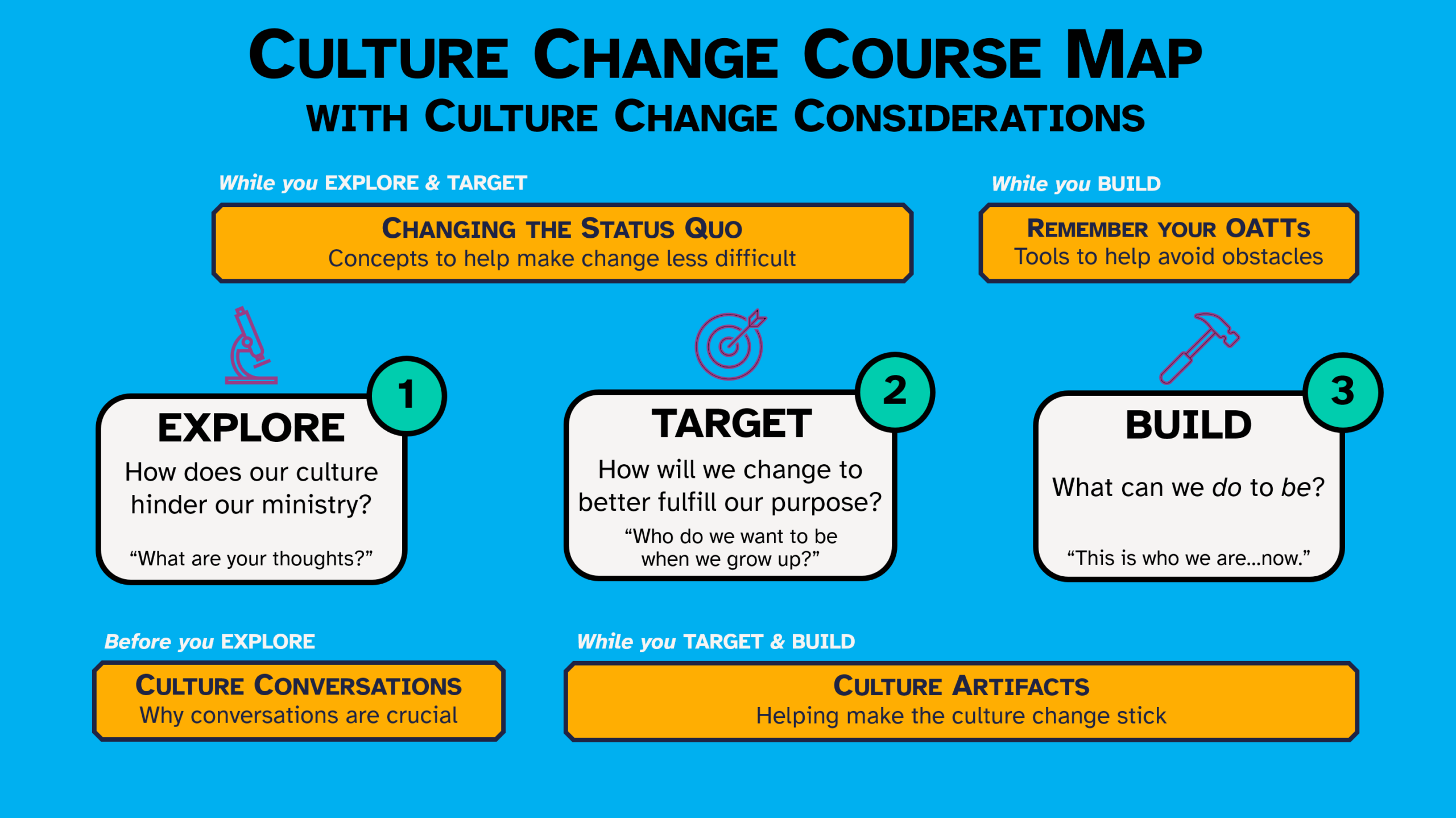
The 5 principles in this section are provided to help you plot your congregation’s unique culture change journey, adjusting the information, tools, and steps of the Culture Change Course Map to your specific situation.
The Culture Change Course Map is not designed to be one-size-fits-all; each congregation, with its own specific history, challenges, gifts & talents, located in the distinct community where God has placed them to fulfill his purpose, will have a unique course for cultural change that is its alone!
Instead, the Culture Change Course Map is designed with a several-sizes-fits-most approach. This several-sizes-fits-most approach means no single congregation will use every tool or check every box. Each step in the Culture Change Course Map will have value, but will look different (maybe slightly, maybe dramatically so!) for your congregation.
If you’re going to consider making alterations to custom fit the course map to your unique journey, you’ve got some decisions to make. What should we add, cut, or modify? What are the tradeoffs between these approaches? How to change an organization’s culture may be something you previously have not given much thought. While the Deep Dive discussion for each step gives guidance on alterations, understanding and applying the five principles below will help you set your congregation’s unique course to shift your culture.
Here are five principles of culture change that can help you get across the finish line:
Understanding these principles and applying them to your journey will significantly improve the likelihood that you successfully shift your culture.
Principle #1
Know the Journey
The first principle is Know the Journey. The first part of this principle is understanding the reason behind the culture journey—the why. At the macro level, this is straightforward: the only worthwhile reason to consider shifting your culture is to help you fulfill your congregation’s purpose. That means that a prerequisite for culture change is that the congregation needs to be clear and aligned on its purpose and how you fulfill that purpose. (This is the reason the Culture Change Course Map has an optional Step 0 — Refocus. Don’t skip this if clarity and alignment are not present. And don’t assume that they are present — rather assume clarity and alignment are NOT present and see if you can uncover overwhelming evidence to the contrary.)
At a more granular level, this principle involves understanding where you are starting from and where you want to end up; your congregation’s specific From | To couplets. This is the purpose for the Explore (Find the Froms) and Target (Determine the Tos) steps in the Culture Change Course Map. Know the Journey means that:
- Your congregation’s From | To couplets are known by all and
- Everyone can explain how building the To culture will help your congregation’s ministry.
The more you discuss the From | Tos, the clearer you will be on the above two points — and that is what Know the Journey is all about.
Principle #2
Leader Led
Culture change simply cannot happen without leadership. Think about it; without someone leading the way, what do you think are the odds of all members collectively shifting a set of common individual thought habits? That’s why the second principle is that culture change must be Leader Led.
Behind this principle is a specific understanding of what leadership is, namely:
Leadership is influence—nothing more, nothing less.
John C. Maxwell
This definition of leadership is not based on position or authority but rather on the impact an individual has on others in the group. This simple view of leadership has many ramifications for culture change.
- Since everyone influences others at some time, we all have a role to play in culture change.
- Since congregations tend to have a core group that does the majority of the stuff that gets done, that core group will have an outsized influence and thus need to be more involved in the culture shift.
- Some folks have been placed by God in a role that calls them to exercise leadership even more frequently; they need to be even more involved in the culture shift.
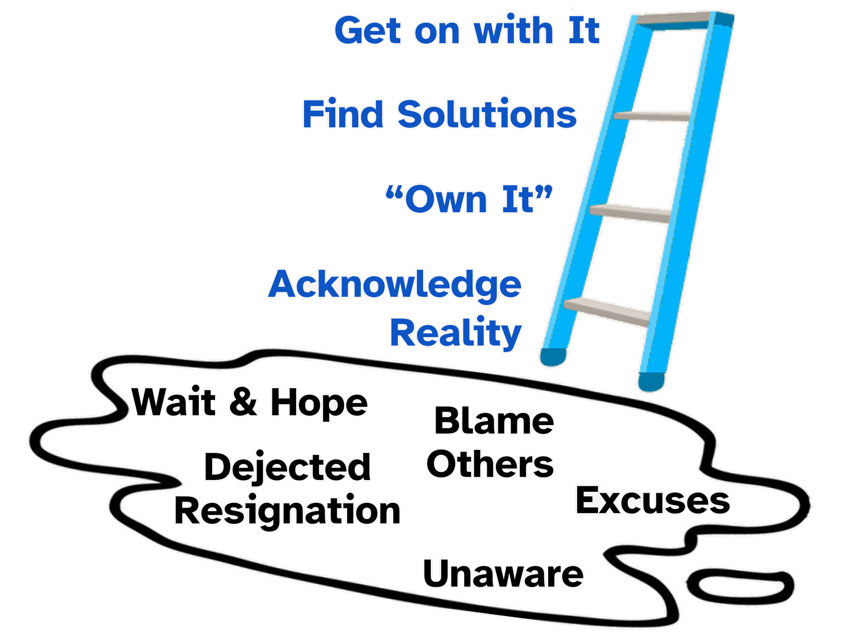
Understanding this view of leadership, we can then examine two aspects of the Leader Led principle. The first is that leaders need to own the journey. This ties directly into the accountability ladder. Acknowledge the reality that culture shaping involves changing shared thought habits, realize your influence puts you in a unique position to effect that change, and own it. Hoping that those with less influence can somehow accomplish this task, perhaps even overcoming the indifference of those with more influence, is ludicrous. Leader Led means that leaders need to own the journey and can’t afford to spend any time “playing in the puddle.”
Even beyond that, leaders need to be the journey. This is a direct product of the shadow of the leader. As leaders, we cast a shadow of influence whether we consciously intend to do so or not. Such is the power of folks’ mirror neurons that someone MUST model the new Tos for the group to follow. The influence of mere words will pale in comparison to the example set by the congregation’s leaders. In shifting shared thought habits, the signals sent by the leader’s behavior are paramount. Leader Led means that leaders need to be the journey.
These two aspects of the Leader Led principle, leaders need to own the journey and be the journey, are so powerful that in some cases the Be • Do • Pursue approach covered in the workshop might be all you need to do to launch your congregation on a culture-changing journey. Regardless, it highlights that culture change will not occur without leadership’s shadow changing. It must be Leader Led.
Principle #3
Ensure Critical Mass
Organizational culture is self-perpetuating; you can view organizations as having a strong cultural-change immune system. A little bit here and a little bit there is unlikely to move the needle or shift the culture. That’s why the third principle is Ensure Critical Mass. For a cultural shift to really take hold, the effort needs to be BIG enough in several dimensions:
- Number of folks involved
- Duration of effort
- Density of effort
Number of Folks Involved
You must Ensure Critical Mass with regard to the number of people initially involved in changing their thinking. That is one of the reasons the Explore step has every-member visits and focus groups. The idea that three or four people sit in a meeting, come up with a few thoughts on new ways to do things, and then shift the culture in their congregation is a bit far-fetched. It could happen, but those three or four individuals would need to be really strong leaders who have great influence and are super focused on and in sync with the culture shift.
If, instead, MANY people are thinking about stuff that isn’t normally reflected upon (i.e., Explore your auto-pilot thought habits) and then consider new ways to do things (i.e., Target who you want to become), you simply have a higher viral load for the new way of thinking “infection” to overcome the organization’s cultural-change immune system. Add in the point that given a big enough group, you’ll likely find a few folks in the organization who will be “super-spreaders” — a few folks who are really revved up on the possibilities the culture change enables and are already very active in the church, so they’ve got a lot of opportunities to interact with others and influence them — and you can see why Ensure Critical Mass is important.
This can feel like a burden, but it is also a boost to building your new culture. With more folks involved, there is just naturally more reinforcement going on.
Duration of Effort
Culture change is done collectively, one person at a time.
Ponder that for a bit . . .
The congregation’s shared thought habits need to shift, but that shift occurs person by person. Everyone is on their own personal timeline to adopt new thought habits. This is the rubber band model that is discussed in the workshop. Thus, the timing for your congregation’s culture shift will be uniquely your congregation’s own.
The answer to the question “How long will it take?” is “Until it is done.” This is likely not the answer you were looking for, but the most accurate one we can give. Ensure Critical Mass with regard to the duration; old thought habits die hard, and there are a lot of folks involved.
Density of Effort
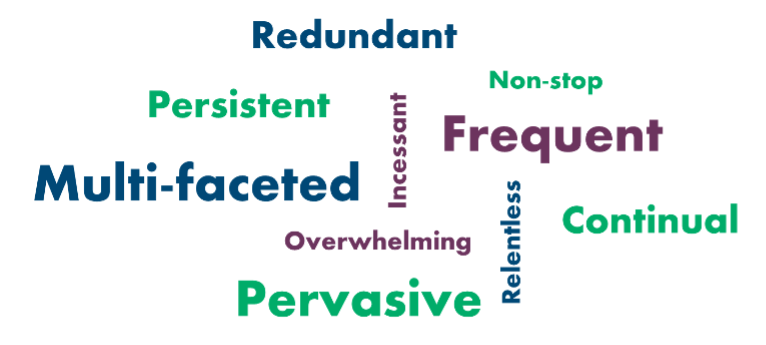 The word cloud to the right has some ways to describe an effective effort to shift culture.
Which one of those words worries you the most?
What one person sees as a pervasive—frequent—multi-faceted effort, another individual can see as overwhelming—incessant—redundant. So how do you find the balance? How much stuff do you need to do to support the culture shift? The answer will vary from congregation to congregation, but it is in large part a function of your capacity for change and the strength of your collective cultural-change immune system.
But it is NOT just about resistance to change. It is also about breaking through and getting past the noise from all the other things going on in our lives. The same quantity of events, emails, sermons, conversations, etc., spread out over a 10-times longer period is not 1/10th as effective; it is more likely only 1/100th as effective.
Whoa! One percent as effective?
Yep.
Consider just a few ways you might highlight the culture change to your congregation. Say you have one meeting this month where the culture shift is discussed. What percentage of the congregation was “exposed” to the meeting. How many members in your congregation have dozens and dozens of meetings or more per month? How big of an impact in helping change thought habits does that one meeting provide? Or say you’ve decided to send an email reminder twice a month on the From | To you are focusing on. Who actually reads it? Of those that do, what impact will that have on the member who routinely gets hundreds of emails a week between work and home?
You need a pervasive, frequent, and multi-faceted approach—a high-density effort—to be able to break through the noise of everything else. You need to overcommunicate about the culture shift; it needs to feel like you’re repeating yourself again and again and over and over because it might take the umpteenth time for the message to be even seen or heard. (Just because you’ve said it a dozen times doesn’t mean they’ve heard it a dozen times. More likely, any given individual was present for less than a handful of those dozen occasions and it only clicked for 1 or 2 of those.)
All this may seem like a bit of a bummer, but there’s good news here, too. Doubling your effort in the first six months isn’t twice as impactful; it’s more like four times as impactful. And if you increase the density of your effort, not only is the desired culture shift WAY more likely, but the duration of time to get there is reduced as well.
So go back and look at that word cloud again. It is still true that what one person sees as a pervasive—frequent—multi-faceted effort, another individual can see as overwhelming—incessant—redundant. The point of this section is that you’re not trying to find balance. If you’re really hitting the mark, someone will see it as a bit much, but for most folks it will simply register. Until you hear a squeal or two about the non-stop culture change stuff, you haven’t overcommunicated with anyone. Put another way: no one ever has regrets about over-investing in the effort for the culture shift.; but lack of critical mass is a frequent point raised post-mortem for difficult or unsuccessful culture shifts.
Principle #4
Evaluate Artifacts
The fourth principle is to Evaluate Artifacts. Sounds kind of like an archeological dig, doesn’t it? In a way it is! From an archeology perspective, an artifact is a human-made object that provides insights into the culture under study, helping us understand who these people were, what they did, and how they thought.
From an organizational culture perspective, artifacts are visible, surface manifestations of culture, such as systems, processes, structures, objects, phrases, rituals, etc. As part of the visible portion of the iceberg, artifacts can help reveal aspects of our culture. 
The thing about artifacts is that we don’t usually think of them as artifacts; this is due to the fish in water syndrome that we talk about in the workshop. A pastor greeting everyone in the sanctuary at the beginning of worship with a hearty “Hello, Christians!” isn’t consciously saying “No one here invites anyone to worship – there are no non-Christians present.”, but as you examine this greeting along with other artifacts, a picture can begin to emerge.
As we work to shift culture we are particularly interested in this attribute of artifacts: they can act as an “external memory” that cue or trigger the “right way” to do things.
Artifacts that trigger perception, thinking, or behaviors associated with From thinking are anchors; these perpetuate the From culture and should be eliminated.
Activators are new artifacts that trigger perception, thinking, or behaviors associated with To thinking. The unfamiliar path of To thinking requires more mental energy; activators are a catalyst, lowering the mental energy to proceed. Thus, you can view activators as detour signs to help us to depart from the default From path. Creating these makes it much more likely for the new thinking to become an auto-pilot response, i.e., a thought habit.
Here are some examples of things in the area of outreach that could be anchor artifacts:
NOTE: These could be anchors based on the thinking the artifacts promote and the behaviors that show up as a result.
- Meeting agendas that never include anything about outreach.
- An evangelism committee structure that is big on congregational events, advertising, and new guest follow-up but doesn’t have anyone assigned to equip the saints for personal outreach. (Roles and responsibilities are powerful artifacts; if something is “my job,” folks tend to focus on that.)
- Assigned greeters. (If something is NOT “my job,” folks tend to NOT focus on that.)
- Perhaps something as seemingly trivial as referring to that person who walks through the church door for the first time as a “visitor” (as opposed to a “guest”) could be an anchor.
Here are some examples of things that could be activator artifacts for an outreach mentality:
- Making it a point for every council meeting agenda item to have a discussion on how it might impact outreach.
- A comment by the pastor before dismissing the congregation that welcomes guests and invites them to have a cup of coffee because “We’d love to have the opportunity to get to know you!”
- A geo-marker set on my phone that automatically reminds me when I arrive at Mike’s Barber Shop that one of my personal outreach goals is to reach out to Mike.
Activators work best when
- They are simple to understand—double bonus if it makes it feel strange to not act in a way consistent with the To thinking!
- They exist when and where the behavior will take place (the geo-marker example above may seem strange, but it sure lands firmly on this point!), and…
- People are already motivated to think in the new way; they just need a nudge. Hopefully, the work you’ve done in the Explore and Target steps sets the stage for this.
Evaluating anchors to jettison and activators to try out initially occurs in the Target step. As you proceed with the Build step, it could be helpful to conduct another reevaluation of artifacts. This is because once you’re actually in the Build step, you’ll start to see culture aspects that were not apparent in the Target step – some surprising anchors may become visible. Also, it is unlikely that all your activators will be effective – you may wish to pitch and replace a few. Again, once you’re in the Build step, you’ll start to see culture aspects that were not apparent in the Target step – you will come up with different activators as a result.
One last point: artifacts are visible, surface manifestations of culture, but anchors are not always easy to recognize as triggering From thinking. When you Evaluate Artifacts, finding and eliminating anchors is usually more effective as a team sport. Ditto for creating activators; the more folks that are involved in creating them, the more likely you’ll identify a really impactful activator plus the more folks who are pre-dispositioned to that helpful nudge.
Principle #5
Do to Be
The fifth and final principle is Do to BE. This is the core of the Build step. At this point, folks are aligned on the From | Tos and clear on how this will support the congregation’s ministry; leaders are out front, modelling who the congregation wishes to be. Anchors have been identified and jettisoned, activators are being rolled out and tested. Folks are trying out some new ways of thinking. That’s great!
However, thinking these new thoughts isn’t a culture change; you’ve go to build this way of thinking to habit-strength. Clear From | Tos are a new path in the forest of your mind, but it is just the equivalent of a footpath hacked through the jungle with a machete. Meanwhile, our established thought habits are pristine boulevards without any other traffic—that is the easy path our thoughts will be inclined to take because it is so effortless and comfortable. Building up the new path so it is the preferred route is what Do to BE is all about. Developing the path, widening, leveling and smoothing it, so that it becomes easier to take the new neural path than the old one is how you make this the autopilot thinking that automatically leads to the desired behaviors.
Do to BE is essentially acting in accordance with the To until it becomes your new default. Dos consistent with the Tos are identified during the Target step and then put into practice as part of the Build step. Each mental rep of a Do gives you four opportunities to build up that alternate neural path in the brain and get closer to making the To thinking a thought habit:
- REPETITION of acting upon the new way of thinking
- RESULTS from behavior produced by the new way of thinking
- REFLECTION upon the new way of thinking
- ENCOURAGEMENT for the new way of thinking
REPETITION of acting upon the new way of thinking
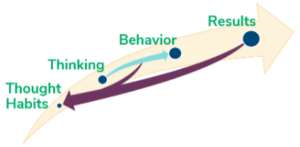
Just like practicing a musical instrument or any sport, getting our mental reps in will make things easier in the future; it will build the mental path. Every time we think differently and consequentially act differently (the light blue arrow in the image below), we are making that an easier path to travel and helping shift the conscious thought into a subconscious thought habit. This is represented by the purple arrow in the diagram below.

RESULTS from behavior produced by the new way of thinking
The results that arise from a behavior can help shift the conscious thought that led to that behavior into a subconscious thought habit. Here it is of vital importance how we frame the result.
For example, let’s say someone has some new thinking, namely, “God has placed me here in this neighborhood where I live so I can reach out to my unchurched neighbors.” Their new behavior is they strike up a conversation with their neighbor, with a goal of somehow connecting them to the gospel. As a result, in that conversation they invite their neighbor to church.
The invitation to church is the result. Isn’t that awesome! New thinking led to new behavior and produced a new result!
But what if the neighbor declines the invitation? This is where framing the result is absolutely critical. If we frame the result as “getting them in the pew” —something we do not control and may only lightly influence—it will not reinforce the new thinking, and we’re not helping shift it into a thought habit. We’ll see the unaccepted invitation as a failure.
If we frame the result as an invitation made—something we do control—we can view the result as a success! This will reinforce the new thinking and help shift it into a thought habit. This is represented by the additional purple arrow in the diagram below.
How we frame the results is another way the journey is Leader Led.
REFLECTION upon the new way of thinking
Thinking about “What just happened?” when we acted in a new way consistent with the new way of thinking is essentially a way to double-dip and get another mental rep from the behavior just undertaken. Being curious about your thinking and its impact is a way to build the mental path. It can include questions such as…
- How did that go?
- What might I do differently the next time to improve the result or strengthen the habit?
Over time, it’s also worth reflecting on how what was initially hard or uncomfortable now seems to be easier or more natural.
Self-reflection is great; reflection and discussion with others is even better! Just talking with others about how things are going for a new Do associated with the target To is SO powerful; it helps build the commonality of the thought habit; it’s shared aspect. (See Group Conversations in the Build Step for more thoughts on this.)
It also opens the door for the final opportunity to cultivate the new way of thinking: encouragement.
Group Conversations in the Build Step
Odds are MOST people in the group will not just lock into the new way of thinking at the beginning. For most, it will feel different, perhaps unnatural. These folks will likely initially describe it as uncomfortable or not easy-flowing for them, or perhaps they’ll point to the result and see that it is a bit off-target.
One great way to help these folks is for them to simply have conversations with others about the ongoing culture shift. How do we promote those types of discussions? Maybe you’ll pair folks up in the congregation to be culture-change partners; giving them someone to have a 1-on-1 conversation with and help hold accountable — a sort of mental-change workout buddy. Another avenue lies in events that bring folks together to take stock of the ongoing culture change effort; including some paired share and then group discussion. See the Build section for more thoughts on this. Realize also that you probably cannot have too many of these conversations (Ensure Critical Mass!)
As folks struggle with the chaos of a culture shift, these conversations provide a place to voice questions that will naturally arise. Here are just a few, along with insights folks may have in the discussion:
| Question | Insight |
|---|---|
| Is my discomfort/unease normal? | Yes, it is. |
| Are others struggling, too? | Yes, they are. |
| Is anyone getting there? | Someone is. |
| What are those folks doing? | They are doing... |
| Is this all worth it? | Yes! It advances the kingdom in this (these) ways... |
Look back at this list and consider how powerful each insight could be for someone struggling with an aspect of the culture shift. Notice the opportunities for Reflection and Encouragement. Imagine a part of the conversation where an individual who needs reframing of results – not an uncommon issue for those struggling with the change – is supported and facilitated.
These conversations are SO vital because changing culture means changing shared thought habits. However, people’s thoughts are hidden; you can only see the Dos. You’ll need to have conversations to make the thinking visible. When we see or hear about a new/different behavior that seems consistent with the desired new thinking, we’ll want to reinforce that. However, we’ll need to NOT assume the thinking that drove that behavior. The thinking is hidden; only the behaviors and results are visible. That means we’ll need to have discussions similar to those we had in the workshop, sharing not just what we did or did not do but also why we acted that way, which probably will include our feelings and or fears in that moment. That aspect of the conversation – being vulnerable, sharing setbacks, being accountable and sharing your self-reflections on “What can I do to impact this?” – is another way the journey is Leader Led.
Lastly, as stated before, culture change is done collectively, one person at a time. These conversations are where all the individual journeys are realigned and synchronized. Whatever your congregation’s culture change journey looks like, make sure there are plenty of opportunities for group shared reflection in the Build phase. (Ensure Critical Mass!)
ENCOURAGEMENT for the new way of thinking
The last opportunity to build up that alternate neural path in the brain and get closer to making the To thinking a thought habit is ENCOURAGEMENT. Unfortunately, this is the one of the four opportunities that is most easily dropped. There are several reasons:
- We tend to be negative sorters; self-reflection and encouragement are not a natural combination for most.
- Unless you directly observe a behavior and initiate a follow-up in a conversation or have designed group conversations (per the Group Conversations in the Build Step sidebar), the opportunity may never arise.
- You may be struggling with the shift yourself and feel unqualified or unready to offer encouragement. (Securing and adjusting your own mask before helping others is conventional wisdom that we hear before every takeoff! That might not be the best approach in this case, but it certainly is a thought habit that will show up for some.)
- If you are more task-focused rather than relationship-focused (which is about 50% of us!), offering encouragement might not be a natural strength for you.
This means there is yet another way in which the journey is Leader Led. Here are a few ways to capture this opportunity:
- Make sure you intentionally provide opportunities for encouragement to happen. Create an encouragement artifact by making gratitude or appreciation part of a formal agenda (Not only in Group Conversations in the BUILD Step, but also in meetings, right after the opening prayer of a Bible study, as part of the post-service announcements, etc.)
- Help put folks high on the mood meter. Voice your appreciation for the effort, highlight progress made, and come with curiosity as you look at those on the leading edge of the rubber band.
- Maintain and vocalize your optimism for the eventual success of the culture shift. Your positive attitude as a leader will undoubtedly impact others via their mirror neurons. Being intentional and deliberate about modelling a positive outlook will also help you maintain that for yourself.
- Help others find a solution they can imitate. Recognizing a path forward when you thought there wasn’t one to be found is very powerful. Making the hidden visible and addressing blind spots, your self-reflections on “What can I do to impact this?”, and highlighting the earlier implementers in the culture shift rubber band all fall into this category. This might be a natural path for those who are more task-focused. Just realize that the task is “help them find their insight”, not “provide them a plug-and-play solution”; their self-discovery goes MUCH further in building the new thought habit.
Each of these four opportunities helps you magnify the impact of each mental rep of a Do and build up that alternate neural path in the brain to make the To thinking a thought habit. This is why Do to BE is the core of the BUILD step.
Conclusion
Using the Five Principles
Understanding and applying these five principles are the key to adjusting the information, tools, and steps of the Culture Change Course Map to your specific situation. While they’ll be referred to throughout each step’s material, it could be helpful to reread them at the beginning of each step in the Culture Change Course Map to help you plot your congregation’s unique culture change journey.